

Is no plan the best plan?
In June 1987, myself and two good friends finished our end of school exams and headed off for a month on the rails with nothing but interrail passes, passports, a small amount of money in many different currencies and a large amount of enthusiasm.
We only had the very barest outline of a plan. We would start in Dublin. We would go to a Greek island called Spetses. Since we all lived in Dublin and very much hoped to be starting university in September we were always going to finish up back in Ireland.
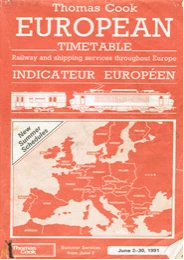
We also brought with us the single most important book to bring on an interrail – the Thomas Cook European Timetable. This little red piece of excellence was invaluable when it came to planning as it showed all the trains and connections you could ever need. It was printed monthly at the time and could be bought at bigger mainline stations or serious travel agents in most big cities. Those of us on a budget would ask for a copy of last months timetable since the details didn’t change from month to month and they would be replaced by the new edition.
While the timetable ultimately ceased being published by Thomas Cook it was restarted after a few months and you can now get the printed edition of the European Rail Timetable 4 times a year.
I have managed to piece the route back together using a combination of the photos that I took, my Thomas Cook from 1991, and a couple of key memories that have stuck with me in the almost 40 years since then.
Thanks to the “get on a train and go somewhere” feeling you get with an Interrail pass this trip expanded to take in Portugal and Norway as well. Here’s how it all happened.
Early days Dublin-Paris-Amsterdam
Our first train was from Dublin Connolly to Rosslare. Back in those days the Interrail ticket had no allowance for inbound or outbound days in your own country, so these might well have been the most expensive tickets of our entire holiday.
While waiting for the boat I went up to the bank in Rosslare and tried to get a bag of 5p coins which were the same size as DM1 coins and were supposed to be suitable replacements in vending machines and payphones when in West Germany. I didn’t get the coins, and I also didn’t end up making it to West Germany either.
We got the ferry overnight from Rosslare to Le Havre and a train to Paris. We were due to meet up with a friend who had been in Paris for a couple of weeks. The plan, such as it was, involved meeting at 18:00 under the Arc de Triomphe on the day we arrived in France. Looking back at it now, this was not really a very robust plan.
Our friend wasn’t there. Mobile phones were approximately 15 years in the future and we had no way to get in touch to re-arrange our rendez-vous. We left Paris. That was France.
Next stop – Amsterdam. I know we headed for Amsterdam because I have a photo of the 3 of us in a couchette carriage with a note on the back saying “On our way to Amsterdam”. I don’t know what happened on that trip, but after that photo the next one on the roll was taken in Madrid.
We got to Amsterdam, went to a supermarket to buy supplies, and then split up. The others went to West Berlin. I should probably have gone with them, but I had somehow decided that because I could go to Lisbon, I should go to Lisbon. So I did.
It’s also possible that I just got in a mood because I hadn’t been in charge of any of the route planning yet and decided I was going to go very, very far away. I was very stubborn back then. I have mellowed a little since then.
In terms of food, in those days my regular shopping basket would have contained chocolate, biscuits, crisps, bread, some sort of cheese, more biscuits, maybe some fruit, and a drink of some sort. Coming from Ireland, where water just came out of taps, it never even ocurred to me to spend money on “just water” when I could spend the same amount and get all that extra sugar and fizz and chemicals. My dentist probably wouldn’t approve.
Solo time Paris-Madrid-Lisbon-Paris
The lack of photos between us heading north to Amsterdam and then me heading south towards Madrid tells me that I didn’t stop for long anywhere along the route. I must have taken a train back from Amsterdam to Paris, and then the “Paris-Madrid Talgo1” which went through a gauge-changing process at the border from French to Spanish gauge. This avoided the need to phyiscally change trains at the border in the middle of the night.
I had a couple of hours in Madrid and then took the overnight “Estrella Lusitania2” to Lisbon. I remember being told by someone that falling asleep on a bench beside the railway station in Lisbon was not wise, but I think I fell asleep anyway. At this stage I had been on the move for about 40 hours since leaving Paris so I deserved a nap.
I had a few hours to explore Lisbon before leaving on the “Eca de Queiroz3” to meet up with my friends again in Paris. This train got me as far as Hendaye on the French side of the border with Spain where there was a timetabled connection to Paris4.
In all, it had been 67 hours and 5 minutes between leaving Paris on the evening of the 1st day and returning on the afternoon of the 4th day. I had spent just under 24 of those hours either in Madrid or Lisbon, and almost 43 of them in transit. Madrid and Lisbon ended up on my “must come back to visit some time” list. I finally made it back to Lisbon towards the end of 2021, as COVID travel restrictions were lifting. Madrid is still on the list.
Back together Paris-Zurich-Vienna-Athens-Spetses
After meeting back up in Paris we headed east, spending the day in Liechtenstein and then we tool an overnight train from Zurich to Vienna. We spent two days there visiting the main tourist spots. Vienna was supposedly a hub of intrigue in those days, or at least according to the spy books I read. We didn’t spot any spies while we were there. Their disguise must have been excellent.
We left Vienna on the “Hellas Express5”, passed behind the iron curtain to trundle through Budapest and Belgrade and came out the far side, arriving in Athens about 35 hours. Surprisingly, I have very little recollection of the places that we passed through on our way south. This is a great pity since it was the only time I managed to visit what was then very much foreign territory for me – the “Eastern Bloc”.
I see from the notes for the train that there was only seating accommodation from Vienna to Athens, no sleepers or couchettes. This cannot have been comfortable. I also see that it joined up with a train (the “Puskin”) which left Moscow Kievski at 1430 a day before we left Vienna and continued on with us all the way to Athens.
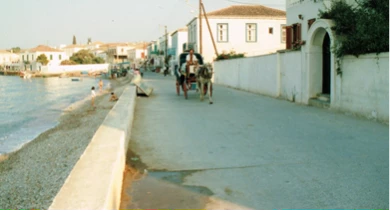
Based on the photos I have, we spent the day in Athens doing very touristy things like visiting the Acropolis before getting a train out to Pireaus and a ferry from there to Spetses. We stayed on the island for a number of days. To this day I still don’t understand what it was that put Spetses on our itinerary as against any of the other Greek islands, but I can say for sure that I enjoyed my time there.
Go north Spetses-Rome-Paris-Hamburg
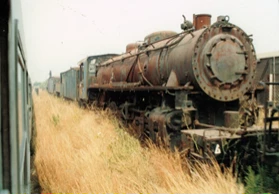
We took a ferry back from Spetses to Athens, and then the narrow gauge line6 to Patras. This originated in Athens and then split in Corinth, with one branch going to Kalamata and the other to Patras. This line is now closed unfortunately. Along the way I got some great photos of old steam engines quietly rusting beside the line. I also remember the absolute joy to be felt while trundling along through the Greek countryside, sitting on the carriage steps with the door open. I’m sure health and safety might have a thing or two to say about that these days.
Looking at the timetable for sailings between Patras & Brindisi there were plenty of sailings7 available. Most of them called in to Igoumenitsa and Corfu en-route and since my young travel nerd brain would remember if we had visited two extra places in Greece, even if only for an hour I’m pretty sure we took the only direct sailing8.
We made our way up to Rome and spent the day admiring the Colosseum, the Spanish Steps and the Vatican. Roma Termini stuck in my mind as a great design and I have always wanted to go back and visit. This year I will finally get to go back and experience it again.
The “Palatino9” left Rome relatively early in the evening and called in to Firenze just before 9 o’clock before continuing on towards Paris. After leaving Rome we took off our shoes, stretched out on the seats, pretended to be asleep and generally looked and smelled like (and were) 3 teenage boys halfway through an Interrail. This was designed to stop people coming into our compartment in Firenze. It didn’t work, but we gave it our best shot.
Paris to Hamburg10 gave us the experience of a novel compartment type introduced by SNCF – the “Cabine 8”. These were effectively bunk beds stacked 4 high, with 8 people per compartment. A regular couchette holds 6 per compartment, so you can imagine how little room each person got with 7 other travellers. They were the same price as an ordinary seat and didn’t come with the extra cost of a couchette, so to us budget conscious travellers these were perfect. I think that the fact that SNCF only ran them for a few years might be explained by the fact that they weren’t very comfortable. But they were free.
Split again Hamburg-Frederikshavn-Gotteborg-Narvik
At this stage we had split into two groups again. Two of us were determined to get as far north as we could – all the way up to the Arctic Circle. The other went to Groningen, for some reason known only to himself.
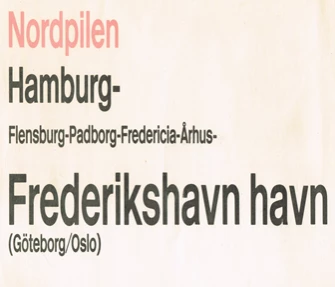
After a quick transfer to Hamburg Altona we continued our trek north. We went from Hamburg to Frederikshavn on the “Nordpilen11”. I know we took this train because I have a piece of branded swag (apologies, DSB, it was a long time ago, I was young, I meant to bring it back, etc . . .) which showed that there was a timetabled route all the way from Hamburg to Oslo, via Frederikshavn and Goteborg. According to my 1991 Thomas Cook the “Nordpilen” only went as fas as Fredericia, but there were still connections available.
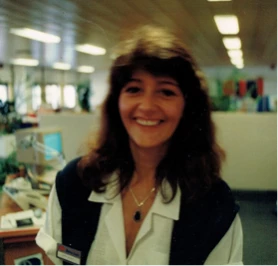
From Frederikshavn we took the ferry across to Goteborg/Gothenburg. In the pre-internet days we could only buy tickets for the ferry when we arrived in the port, so we headed up to the ticket desk. We got on well with the person behind the desk and I have a photo of her with a big smile on her face. She was wondering what on earth we were thinking when we explained our plans.
On the crossing to Goteborg we met a young family on their way back to Sweden. We shared food (meaning, we ate their food) and had a great chat. Meeting and remembering these people is a reminder of the great chance meetings that you can have while on an interrail.
We only had seats on the daily sleeper12 from Gothenburg to Narvik. Back in 1987 we were probably afraid to ask the price for a couchette in Scandinavia, but I’m happy to report that a more recent trip in 2023 reveals prices to be very reasonable.
My mental notes from the trip up to Narvik were “trees, lakes, trees, trees, mountains, trees on mountains, lakes below mountains, trees, trees” The photos I took reflect this. I know the route is very scenic, but I think my camera, low cloud and a moving train didn’t make for optimal conditions.
We eventually ran out of tracks. There’s nowhere further north to go. We took a whole load of photos, all of which were a variation on the theme of “us swimming in a fjord in the Arctic Circle a few days after the solstice” or “look, we’re in Narvik”. We walked up the hill behind Narvik to try to eke out the last of the sunlight, walked back down again, slept on the platform, and got the next train out of Narvik. That was Norway.
Looking back, I think we were the archetypes of the modern hit and run tourist – we probably didn’t interact with any Norwegians and we certainly didn’t contribute anything to the economy unless you count my return visit in 2023 which was really based primarily on the memory of the few hours I spent there in 1987.
Homeward bound Narvik-Dublin
I have a photo of our train carriage rolling abord the m/f “Holger Danske”which sailed between Helsingborg and Helsingor, then sunset over fields in Denmark, then on the deck of another ferry between Rodby and Puttgarden. This was in the days when trains between Germany and much of Denmark regularly travelled by ferry between these two ports as it was the shortest route available. This has now been replaced by connections using tunnels. The tunnels are faster, but way less cool than being in a train on a boat.
After leaving Denmark there’s no record. The next photo on the roll is of the three of us on the boat back from France to Ireland. As with the trip to Spain, the absence of photos for a significant part of the route tells me only one thing – we didn’t stop much between Narvik and Le Havre. In those days there were direct trains (or at least through carriages that were tacked onto different trains) from Hamburg to Paris, so I imagine that’s the route we took.
At this stage the three of us had spent all our money. Back then there was no way to “get” money. You either had it as cash or travellers cheques, or else . . . well, you just had no money. Luckily I had a credit card on my Dads account in case of emergencies. This wasn’t quite an emergency as such, but we decided that the best thing for us would be to hit the all you can eat buffet on the ferry, and eat all we could. We certainly got our moneys worth that time.
In the decade after this trip I took a few more Interrails, including one memorable holiday visiting my girlfriend (now my wife) who was working in Leiden for the Summer. This was actually made up of two seperate long weekend trips where I sailed from Dublin after work on Thursday evening, got the train to London and then on to Dover, a ferry across to Oostende and then train to Leiden and managed to be there before she finished work on Friday.
There was a 30 year gap in my Interrailing until 2023 when we bought a 3 month pass and revisited some of our old destinations, including Leiden. We have been regular Interrailers since then and plan on continuing for a long time to come. We might even make it to Madrid and I can tick another “must come back to visit some time” place off the list.
1Table 58. Depart Paris Montparnasse 20:00. Arrive Madrid Chamartin 08:32.
2Table 44. Depart Madrid Chamartin 23:00. Arrive Lisbon Santa Apolonia 08:45.
3Table 58. Depart Lisbon Santa Apolonia 17:35. Arrive Hendaye 08:45.
4Table 58. Depart Hendaye 09:38. Arrive Paris Montparnasse 15:05.
5Table 88. Depart Vienna Westbf 19:05. Arrive Athens 05:45.
6Table 980. Depart Athens 09:25. Arrive Patras 14:43.
7Tables 1490, 1525, 1533, 1537.
8Table 1490. Depart Patras 18:00. Arrive Brindisi 10:00. Adriatica Navigazione.
9Table 34. Depart Roma Termini 19:10. Arrive Paris Gare de Lyon 10:07.
10Table 62. Depart Paris Gare du Nord 21:37. Arrive Hamburg Hbf 07:46.
11Table 461. Depart Hamburg Altona 08:39. Arrive Frederikshavn 15:55.
12Tables 473, 476. Depart Gothenburg 18:00. Arrive Narvik 20:12.